拍照实践(C/C++)
在开发相机应用时,需要先申请相关权限。
当前示例提供完整的拍照流程及其接口调用顺序的介绍。对于单个流程(如设备输入、会话管理、拍照)的介绍请参考相机开发指导(Native)的具体章节。
开发流程
在获取到相机支持的输出流能力后,开始创建拍照流,开发流程如下。
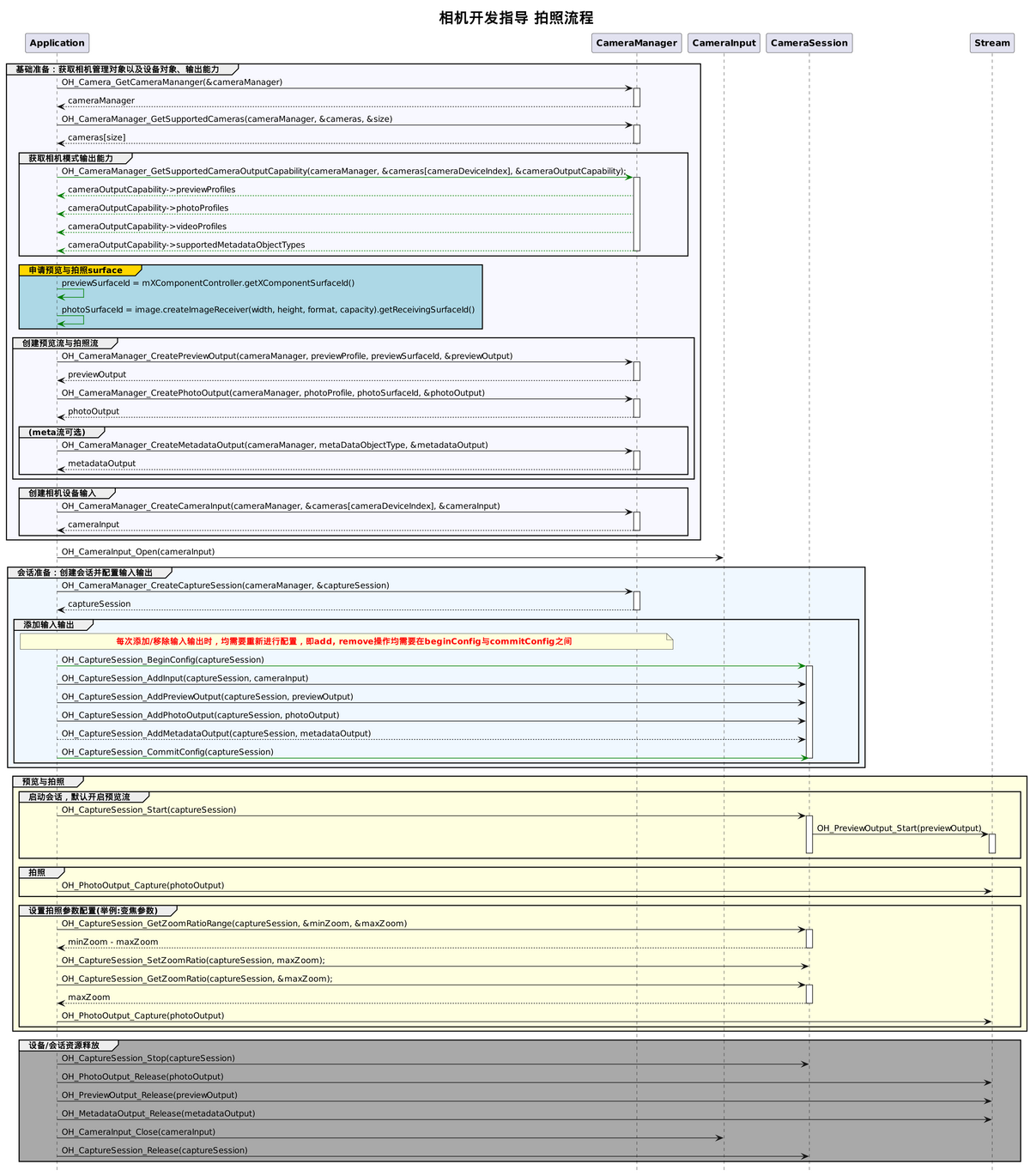
完整示例
-
在CMake脚本中链接相关动态库。
target_link_libraries(entry PUBLIClibace_napi.z.solibhilog_ndk.z.solibnative_buffer.solibohcamera.solibohimage.solibohfileuri.so) -
创建头文件ndk_camera.h。
#include "ohcamera/camera.h"#include "ohcamera/camera_input.h"#include "ohcamera/capture_session.h"#include "ohcamera/photo_output.h"#include "ohcamera/preview_output.h"#include "ohcamera/video_output.h"#include "ohcamera/camera_manager.h"class NDKCamera {public:~NDKCamera();NDKCamera(char* previewId);Camera_ErrorCode RegisterBufferCb(void* cb);}; -
cpp侧导入NDK接口,并根据传入的SurfaceId进行拍照。
#include "hilog/log.h"void CaptureSessionOnFocusStateChange(Camera_CaptureSession* session, Camera_FocusState focusState){OH_LOG_INFO(LOG_APP, "CaptureSessionOnFocusStateChange");}void CaptureSessionOnError(Camera_CaptureSession* session, Camera_ErrorCode errorCode){OH_LOG_INFO(LOG_APP, "CaptureSessionOnError = %{public}d", errorCode);}CaptureSession_Callbacks* GetCaptureSessionRegister(void){static CaptureSession_Callbacks captureSessionCallbacks = {.onFocusStateChange = CaptureSessionOnFocusStateChange,.onError = CaptureSessionOnError};return &captureSessionCallbacks;}void PreviewOutputOnFrameStart(Camera_PreviewOutput* previewOutput){OH_LOG_INFO(LOG_APP, "PreviewOutputOnFrameStart");}void PreviewOutputOnFrameEnd(Camera_PreviewOutput* previewOutput, int32_t frameCount){OH_LOG_INFO(LOG_APP, "PreviewOutputOnFrameEnd = %{public}d", frameCount);}void PreviewOutputOnError(Camera_PreviewOutput* previewOutput, Camera_ErrorCode errorCode){OH_LOG_INFO(LOG_APP, "PreviewOutputOnError = %{public}d", errorCode);}PreviewOutput_Callbacks* GetPreviewOutputListener(void){static PreviewOutput_Callbacks previewOutputListener = {.onFrameStart = PreviewOutputOnFrameStart,.onFrameEnd = PreviewOutputOnFrameEnd,.onError = PreviewOutputOnError};return &previewOutputListener;}void OnCameraInputError(const Camera_Input* cameraInput, Camera_ErrorCode errorCode){OH_LOG_INFO(LOG_APP, "OnCameraInput errorCode = %{public}d", errorCode);}CameraInput_Callbacks* GetCameraInputListener(void){static CameraInput_Callbacks cameraInputCallbacks = {.onError = OnCameraInputError};return &cameraInputCallbacks;}void CameraManagerStatusCallback(Camera_Manager* cameraManager, Camera_StatusInfo* status){OH_LOG_INFO(LOG_APP, "CameraManagerStatusCallback is called");}CameraManager_Callbacks* GetCameraManagerListener(){static CameraManager_Callbacks cameraManagerListener = {.onCameraStatus = CameraManagerStatusCallback};return &cameraManagerListener;}static void* bufferCb = nullptr;Camera_ErrorCode NDKCamera::RegisterBufferCb(void* cb) {OH_LOG_INFO(LOG_APP, " RegisterBufferCb start");if (cb == nullptr) {OH_LOG_INFO(LOG_APP, " RegisterBufferCb invalid error");return CAMERA_INVALID_ARGUMENT;}bufferCb = cb;return CAMERA_OK;}void OnPhotoAvailable(Camera_PhotoOutput* photoOutput, OH_PhotoNative* photo) {OH_LOG_INFO(LOG_APP, "OnPhotoAvailable start!");OH_ImageNative* imageNative;Camera_ErrorCode errCode = OH_PhotoNative_GetMainImage(photo, &imageNative);OH_LOG_INFO(LOG_APP, "OnPhotoAvailable errCode:%{public}d imageNative:%{public}p", errCode, imageNative);// 读取 OH_ImageNative 的 size 属性。Image_Size size;Image_ErrorCode imageErr = OH_ImageNative_GetImageSize(imageNative, &size);OH_LOG_INFO(LOG_APP, "OnPhotoAvailable imageErr:%{public}d width:%{public}d height:%{public}d", imageErr,size.width, size.height);// 读取 OH_ImageNative 的组件列表的元素个数。size_t componentTypeSize = 0;imageErr = OH_ImageNative_GetComponentTypes(imageNative, nullptr, &componentTypeSize);OH_LOG_INFO(LOG_APP, "OnPhotoAvailable imageErr:%{public}d componentTypeSize:%{public}zu", imageErr,componentTypeSize);// 读取 OH_ImageNative 的组件列表。uint32_t* components = new uint32_t[componentTypeSize];imageErr = OH_ImageNative_GetComponentTypes(imageNative, &components, &componentTypeSize);OH_LOG_INFO(LOG_APP, "OnPhotoAvailable OH_ImageNative_GetComponentTypes imageErr:%{public}d", imageErr);// 读取 OH_ImageNative 的第一个组件所对应的缓冲区对象。OH_NativeBuffer* nativeBuffer = nullptr;imageErr = OH_ImageNative_GetByteBuffer(imageNative, components[0], &nativeBuffer);OH_LOG_INFO(LOG_APP, "OnPhotoAvailable OH_ImageNative_GetByteBuffer imageErr:%{public}d", imageErr);// 读取 OH_ImageNative 的第一个组件所对应的缓冲区大小。size_t nativeBufferSize = 0;imageErr = OH_ImageNative_GetBufferSize(imageNative, components[0], &nativeBufferSize);OH_LOG_INFO(LOG_APP, "OnPhotoAvailable imageErr:%{public}d nativeBufferSize:%{public}zu", imageErr,nativeBufferSize);// 读取 OH_ImageNative 的第一个组件所对应的像素行宽。int32_t rowStride = 0;imageErr = OH_ImageNative_GetRowStride(imageNative, components[0], &rowStride);OH_LOG_INFO(LOG_APP, "OnPhotoAvailable imageErr:%{public}d rowStride:%{public}d", imageErr, rowStride);// 读取 OH_ImageNative 的第一个组件所对应的像素大小。int32_t pixelStride = 0;imageErr = OH_ImageNative_GetPixelStride(imageNative, components[0], &pixelStride);OH_LOG_INFO(LOG_APP, "OnPhotoAvailable imageErr:%{public}d pixelStride:%{public}d", imageErr, pixelStride);// 将ION内存映射到进程空间。void* virAddr = nullptr; // 指向映射内存的虚拟地址,解除映射后这个指针将不再有效。int32_t ret = OH_NativeBuffer_Map(nativeBuffer, &virAddr); // 映射后通过第二个参数virAddr返回内存的首地址。OH_LOG_INFO(LOG_APP, "OnPhotoAvailable OH_NativeBuffer_Map err:%{public}d", ret);// 通过回调函数,将处理完的buffer传给ArkTS侧做显示或通过安全控件写文件保存,参考拍照(C/C++)开发指导。if (bufferCb == nullptr) {OH_LOG_INFO(LOG_APP, "Current bufferCb invalid error");return;}auto cb = (void (*)(void *, size_t))(bufferCb);cb(virAddr, nativeBufferSize);// 在处理完之后,解除映射并释放缓冲区。ret = OH_NativeBuffer_Unmap(nativeBuffer);if (ret != 0) {OH_LOG_ERROR(LOG_APP, "OnPhotoAvailable OH_NativeBuffer_Unmap error:%{public}d", ret);}}NDKCamera::NDKCamera(char* previewId){Camera_Manager* cameraManager = nullptr;Camera_Device* cameras = nullptr;Camera_CaptureSession* captureSession = nullptr;Camera_OutputCapability* cameraOutputCapability = nullptr;const Camera_Profile* previewProfile = nullptr;const Camera_Profile* photoProfile = nullptr;Camera_PreviewOutput* previewOutput = nullptr;Camera_PhotoOutput* photoOutput = nullptr;Camera_Input* cameraInput = nullptr;uint32_t size = 0;uint32_t cameraDeviceIndex = 0;char* previewSurfaceId = previewId;// 创建CameraManager对象。Camera_ErrorCode ret = OH_Camera_GetCameraManager(&cameraManager);if (cameraManager == nullptr || ret != CAMERA_OK) {OH_LOG_ERROR(LOG_APP, "OH_Camera_GetCameraManager failed.");return;}// 监听相机状态变化。ret = OH_CameraManager_RegisterCallback(cameraManager, GetCameraManagerListener());if (ret != CAMERA_OK) {OH_LOG_ERROR(LOG_APP, "OH_CameraManager_RegisterCallback failed.");}// 获取相机列表。ret = OH_CameraManager_GetSupportedCameras(cameraManager, &cameras, &size);if (cameras == nullptr || size <= 0 || ret != CAMERA_OK) {OH_LOG_ERROR(LOG_APP, "OH_CameraManager_GetSupportedCameras failed.");return;}if (size < cameraDeviceIndex + 1) {OH_LOG_ERROR(LOG_APP, "cameraDeviceIndex is invalid.");return;}// 创建相机输入流。ret = OH_CameraManager_CreateCameraInput(cameraManager, &cameras[cameraDeviceIndex], &cameraInput);if (cameraInput == nullptr || ret != CAMERA_OK) {OH_LOG_ERROR(LOG_APP, "OH_CameraManager_CreateCameraInput failed.");return;}// 监听cameraInput错误信息。ret = OH_CameraInput_RegisterCallback(cameraInput, GetCameraInputListener());if (ret != CAMERA_OK) {OH_LOG_ERROR(LOG_APP, "OH_CameraInput_RegisterCallback failed.");return;}// 打开相机。ret = OH_CameraInput_Open(cameraInput);if (ret != CAMERA_OK) {OH_LOG_ERROR(LOG_APP, "OH_CameraInput_Open failed.");return;}// 获取相机设备支持的输出流能力。ret = OH_CameraManager_GetSupportedCameraOutputCapability(cameraManager, &cameras[cameraDeviceIndex],&cameraOutputCapability);if (cameraOutputCapability == nullptr || ret != CAMERA_OK) {OH_LOG_ERROR(LOG_APP, "OH_CameraManager_GetSupportedCameraOutputCapability failed.");return;}if (cameraOutputCapability->previewProfiles == nullptr) {OH_LOG_ERROR(LOG_APP, "previewProfiles == null");return;}// 根据所需从cameraOutputCapability->previewProfiles中选择合适的预览分辨率previewProfile = cameraOutputCapability->previewProfiles[0];if (cameraOutputCapability->photoProfiles == nullptr) {OH_LOG_ERROR(LOG_APP, "photoProfiles == null");return;}// 根据所需从cameraOutputCapability->photoProfiles中选择合适的拍照分辨率photoProfile = cameraOutputCapability->photoProfiles[0];// 创建预览输出流,其中参数 previewSurfaceId 参考上文 XComponent 组件,预览流为XComponent组件提供的surface。ret = OH_CameraManager_CreatePreviewOutput(cameraManager, previewProfile, previewSurfaceId, &previewOutput);if (previewProfile == nullptr || previewOutput == nullptr || ret != CAMERA_OK) {OH_LOG_ERROR(LOG_APP, "OH_CameraManager_CreatePreviewOutput failed.");return;}// 监听预览输出错误信息。ret = OH_PreviewOutput_RegisterCallback(previewOutput, GetPreviewOutputListener());if (ret != CAMERA_OK) {OH_LOG_ERROR(LOG_APP, "OH_PreviewOutput_RegisterCallback failed.");}// 创建拍照输出流。ret = OH_CameraManager_CreatePhotoOutputWithoutSurface(cameraManager, photoProfile, &photoOutput);// 监听单段式拍照回调。ret = OH_PhotoOutput_RegisterPhotoAvailableCallback(photoOutput, OnPhotoAvailable);// 创建会话。ret = OH_CameraManager_CreateCaptureSession(cameraManager, &captureSession);if (captureSession == nullptr || ret != CAMERA_OK) {OH_LOG_ERROR(LOG_APP, "OH_CameraManager_CreateCaptureSession failed.");return;}// 监听session错误信息。ret = OH_CaptureSession_RegisterCallback(captureSession, GetCaptureSessionRegister());if (ret != CAMERA_OK) {OH_LOG_ERROR(LOG_APP, "OH_CaptureSession_RegisterCallback failed.");}// 开始配置会话。ret = OH_CaptureSession_BeginConfig(captureSession);if (ret != CAMERA_OK) {OH_LOG_ERROR(LOG_APP, "OH_CaptureSession_BeginConfig failed.");return;}// 向会话中添加相机输入流。ret = OH_CaptureSession_AddInput(captureSession, cameraInput);if (ret != CAMERA_OK) {OH_LOG_ERROR(LOG_APP, "OH_CaptureSession_AddInput failed.");return;}// 向会话中添加预览输出流。ret = OH_CaptureSession_AddPreviewOutput(captureSession, previewOutput);if (ret != CAMERA_OK) {OH_LOG_ERROR(LOG_APP, "OH_CaptureSession_AddPreviewOutput failed.");return;}// 向会话中添加拍照输出流。ret = OH_CaptureSession_AddPhotoOutput(captureSession, photoOutput);if (ret != CAMERA_OK) {OH_LOG_ERROR(LOG_APP, "OH_CaptureSession_AddPhotoOutput failed.");return;}// 提交会话配置。ret = OH_CaptureSession_CommitConfig(captureSession);if (ret != CAMERA_OK) {OH_LOG_ERROR(LOG_APP, "OH_CaptureSession_CommitConfig failed.");return;}// 启动会话。ret = OH_CaptureSession_Start(captureSession);if (ret != CAMERA_OK) {OH_LOG_ERROR(LOG_APP, "OH_CaptureSession_Start failed.");return;}// 判断设备是否支持闪光灯。Camera_FlashMode flashMode = FLASH_MODE_AUTO;bool hasFlash = false;ret = OH_CaptureSession_HasFlash(captureSession, &hasFlash);if (ret != CAMERA_OK) {OH_LOG_ERROR(LOG_APP, "OH_CaptureSession_HasFlash failed.");}if (hasFlash) {OH_LOG_INFO(LOG_APP, "hasFlash success");} else {OH_LOG_ERROR(LOG_APP, "hasFlash fail");}// 检测闪光灯模式是否支持。bool isSupported = false;ret = OH_CaptureSession_IsFlashModeSupported(captureSession, flashMode, &isSupported);if (ret != CAMERA_OK) {OH_LOG_ERROR(LOG_APP, "OH_CaptureSession_IsFlashModeSupported failed.");}if (isSupported) {OH_LOG_INFO(LOG_APP, "isFlashModeSupported success");// 设置闪光灯模式。ret = OH_CaptureSession_SetFlashMode(captureSession, flashMode);if (ret == CAMERA_OK) {OH_LOG_INFO(LOG_APP, "OH_CaptureSession_SetFlashMode success.");} else {OH_LOG_ERROR(LOG_APP, "OH_CaptureSession_SetFlashMode failed. ret : %{public}d ", ret);}// 获取当前设备的闪光灯模式。ret = OH_CaptureSession_GetFlashMode(captureSession, &flashMode);if (ret == CAMERA_OK) {OH_LOG_INFO(LOG_APP, "OH_CaptureSession_GetFlashMode success. flashMode:%{public}d ", flashMode);} else {OH_LOG_ERROR(LOG_APP, "OH_CaptureSession_GetFlashMode failed. ret : %{public}d ", ret);}} else {OH_LOG_ERROR(LOG_APP, "isFlashModeSupported fail");}// 判断是否支持连续自动变焦模式。Camera_FocusMode focusMode = FOCUS_MODE_CONTINUOUS_AUTO;bool isFocusModeSupported = false;ret = OH_CaptureSession_IsFocusModeSupported(captureSession, focusMode, &isFocusModeSupported);if (ret != CAMERA_OK) {OH_LOG_ERROR(LOG_APP, "OH_CaptureSession_IsFocusModeSupported failed.");}if (isFocusModeSupported) {OH_LOG_INFO(LOG_APP, "isFocusModeSupported success");ret = OH_CaptureSession_SetFocusMode(captureSession, focusMode);if (ret != CAMERA_OK) {OH_LOG_ERROR(LOG_APP, "OH_CaptureSession_SetFocusMode failed. ret : %{public}d ", ret);}ret = OH_CaptureSession_GetFocusMode(captureSession, &focusMode);if (ret == CAMERA_OK) {OH_LOG_INFO(LOG_APP, "OH_CaptureSession_GetFocusMode success. focusMode%{public}d ", focusMode);} else {OH_LOG_ERROR(LOG_APP, "OH_CaptureSession_GetFocusMode failed. ret : %{public}d ", ret);}} else {OH_LOG_ERROR(LOG_APP, "isFocusModeSupported fail");}// 获取相机支持的可变焦距比范围。float minZoom;float maxZoom;ret = OH_CaptureSession_GetZoomRatioRange(captureSession, &minZoom, &maxZoom);if (ret != CAMERA_OK) {OH_LOG_ERROR(LOG_APP, "OH_CaptureSession_GetZoomRatioRange failed.");} else {OH_LOG_INFO(LOG_APP, "OH_CaptureSession_GetZoomRatioRange success. minZoom: %{public}f, maxZoom:%{public}f",minZoom, maxZoom);}// 设置变焦。ret = OH_CaptureSession_SetZoomRatio(captureSession, maxZoom);if (ret == CAMERA_OK) {OH_LOG_INFO(LOG_APP, "OH_CaptureSession_SetZoomRatio success.");} else {OH_LOG_ERROR(LOG_APP, "OH_CaptureSession_SetZoomRatio failed. ret : %{public}d ", ret);}// 获取当前设备的变焦值。ret = OH_CaptureSession_GetZoomRatio(captureSession, &maxZoom);if (ret == CAMERA_OK) {OH_LOG_INFO(LOG_APP, "OH_CaptureSession_GetZoomRatio success. zoom:%{public}f ", maxZoom);} else {OH_LOG_ERROR(LOG_APP, "OH_CaptureSession_GetZoomRatio failed. ret : %{public}d ", ret);}// 无拍照设置进行拍照。ret = OH_PhotoOutput_Capture(photoOutput);if (ret == CAMERA_OK) {OH_LOG_INFO(LOG_APP, "OH_PhotoOutput_Capture success ");} else {OH_LOG_ERROR(LOG_APP, "OH_PhotoOutput_Capture failed. ret : %{public}d ", ret);}// 停止当前会话。ret = OH_CaptureSession_Stop(captureSession);if (ret == CAMERA_OK) {OH_LOG_INFO(LOG_APP, "OH_CaptureSession_Stop success ");} else {OH_LOG_ERROR(LOG_APP, "OH_CaptureSession_Stop failed. ret : %{public}d ", ret);}// 释放相机输入流。ret = OH_CameraInput_Close(cameraInput);if (ret == CAMERA_OK) {OH_LOG_INFO(LOG_APP, "OH_CameraInput_Close success ");} else {OH_LOG_ERROR(LOG_APP, "OH_CameraInput_Close failed. ret : %{public}d ", ret);}// 释放预览输出流。ret = OH_PreviewOutput_Release(previewOutput);if (ret == CAMERA_OK) {OH_LOG_INFO(LOG_APP, "OH_PreviewOutput_Release success ");} else {OH_LOG_ERROR(LOG_APP, "OH_PreviewOutput_Release failed. ret : %{public}d ", ret);}// 释放拍照输出流。ret = OH_PhotoOutput_Release(photoOutput);if (ret == CAMERA_OK) {OH_LOG_INFO(LOG_APP, "OH_PhotoOutput_Release success ");} else {OH_LOG_ERROR(LOG_APP, "OH_PhotoOutput_Release failed. ret : %{public}d ", ret);}// 释放会话。ret = OH_CaptureSession_Release(captureSession);if (ret == CAMERA_OK) {OH_LOG_INFO(LOG_APP, "OH_CaptureSession_Release success ");} else {OH_LOG_ERROR(LOG_APP, "OH_CaptureSession_Release failed. ret : %{public}d ", ret);}// 资源释放。ret = OH_CameraManager_DeleteSupportedCameras(cameraManager, cameras, size);if (ret != CAMERA_OK) {OH_LOG_ERROR(LOG_APP, "Delete Cameras failed.");} else {OH_LOG_ERROR(LOG_APP, "OH_CameraManager_DeleteSupportedCameras. ok");}ret = OH_CameraManager_DeleteSupportedCameraOutputCapability(cameraManager, cameraOutputCapability);if (ret != CAMERA_OK) {OH_LOG_ERROR(LOG_APP, "Delete Cameras failed.");} else {OH_LOG_ERROR(LOG_APP, "OH_CameraManager_DeleteSupportedCameraOutputCapability. ok");}ret = OH_Camera_DeleteCameraManager(cameraManager);if (ret != CAMERA_OK) {OH_LOG_ERROR(LOG_APP, "Delete Cameras failed.");} else {OH_LOG_ERROR(LOG_APP, "OH_Camera_DeleteCameraManager. ok");}}